Spelling Is Not Encoding
Why words like residents and residence reveal what English spelling actually represents

When you say residents and residence, their pronunciation is exactly the same.
Sound alone can’t tell you how to spell them, but the structure of the word can.
A companion piece to my earlier post, Reading Is Not Decoding
In a previous post I wrote that reading is not decoding.
The same misunderstanding appears on the writing side of the system.
Spelling is not encoding.
A common claim in current literacy discussions is that struggling readers, especially older students, need more encoding practice.
Students say a word, segment the sounds, and write the letters that match those sounds. Teachers correct errors and explain phonics patterns when they appear.
It looks systematic. In many ways it is.
But there’s an assumption underneath this approach:
that spelling is mainly about turning sounds into letters.
That assumption is incomplete.
English orthography preserves three correspondences at the same time:
spelling–meaning
spelling–grammar
grapheme–phoneme
Grapheme-phoneme correspondences are real and important. Students absolutely need to learn how letters represent sounds in words.
But English spelling preserves more than sound. It also preserves the structure and meaning relationships between words.
Consider the words residents and residence.
In natural speech, their pronunciation is exactly the same.
If spelling were simply a matter of encoding sound, we would have no reliable way to distinguish them.
The difference becomes clear only when we look at the structure of the words.
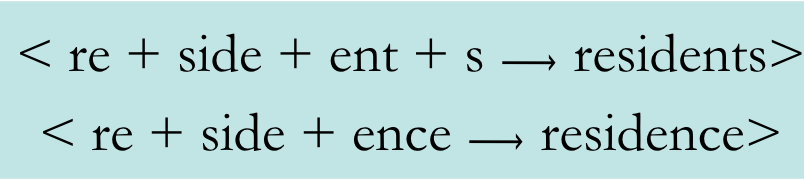
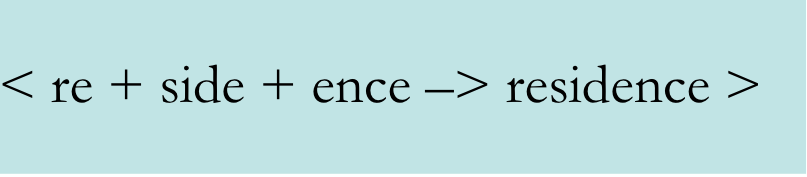
One word refers to people who live somewhere.
The other refers to the state or place of living.
Sound alone cannot tell us which spelling to use.
The structure and meaning of the word does.
Sometimes sound-first explanations even misidentify what the letters are doing.
Take the word been.

The <e> belongs to the base be, and <-en> is a suffix.
Those letters sit next to each other, but they are not functioning as a single grapheme.
The same thing happens in create.
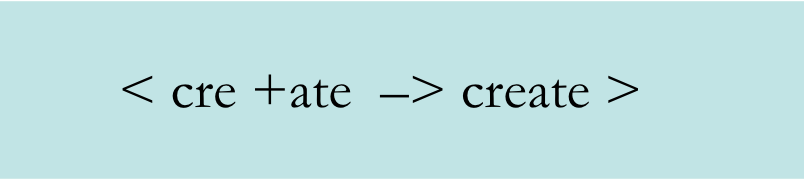
Ignoring structure leads us to invent explanations based on sound alone. Looking at the morphology of the word makes the spelling much clearer.
Word families reveal this system even more clearly.
Consider the word sign.
The <g> is not pronounced. If we tried to spell the word purely from sound, we might reasonably leave it out.
But the spelling makes perfect sense once we look at the word family.
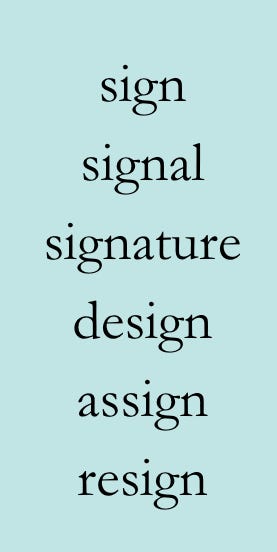
English spelling keeps the base stable so readers and writers can recognize the relationship between related words.
When spelling is reduced to encoding, students are asked to reconstruct words from sound alone.
But sound is the least stable clue in English spelling.
Meaning and structure carry just as much weight, often more.
When students begin investigating word families, bases, and suffixes, something important happens.
Spelling stops looking arbitrary.
The system becomes visible.
Words that once seemed irregular begin to reveal the relationships that hold the language together.
Students are no longer guessing.
They are reasoning.
And once students can see the structure of the system, spelling becomes far less mysterious, and far more learnable.
The goal of spelling instruction isn’t to rebuild words from sound.
It’s to help students see the system that builds the words in the first place.