What’s the Problem with Structured Literacy?
Structured literacy sounds like it should solve the problem.

The phrase suggests order. It suggests seriousness. It suggests instruction that is explicit, systematic, cumulative, diagnostic, and grounded in research. For many children, especially children who were never taught how written words work at all, that may be a real improvement over vague reading instruction, memorized sight words, leveled readers, guessing strategies, and the old habit of hoping children would simply absorb literacy if they were surrounded by books.
I understand why people are drawn to it. If a child has been told to look at the picture, guess from context, memorize whole words, or “just keep reading,” then explicit instruction in grapheme-phoneme correspondences may feel like a rescue.
But structured literacy is not the same thing as Structured Word Inquiry.
And for the struggling learners I work with, that difference is not minor.
Structured literacy also has a history. It was not always called structured literacy. The International Dyslexia Association began as The Orton Society in 1949, changed its name to The Orton Dyslexia Society in 1982, and became the International Dyslexia Association in 1997. IDA describes its own roots as directly connected to Samuel Orton’s work in reading research and multisensory teaching.
The term “Structured Literacy” came later. In 2014, IDA president Hal Malchow described the IDA board’s choice of that term as a decision meant to help market IDA’s approach to reading instruction. He wrote that the name was chosen to include approaches that conform to IDA’s Knowledge and Practice Standards, including Orton-Gillingham, multisensory instruction, explicit phonics, and programs known by names such as Neuhaus and Wilson. He also described the term as an umbrella label for programs that “teach reading in essentially the same way” and as part of building a brand.
That history should be understood by parents. “Structured literacy” can sound as if it simply means literacy instruction with structure. In practice, it often names a particular instructional family, one rooted in Orton-Gillingham, multisensory structured language education, and explicit phonics. That does not mean every teacher using the term is doing the same thing. It does mean parents should not assume the label tells them enough.
I remember when that naming shift happened. By then, Structured Word Inquiry was becoming more visible, and the choice of the phrase “structured literacy” was hard not to notice. I cannot prove why that name was chosen, and I do not need to. The documented point is already enough: structured literacy was adopted as an umbrella label for Orton-Gillingham-based and multisensory phonics-based instruction. It is not Structured Word Inquiry.
The problem with structured literacy is not that it is structured. The problem is that the structure is often built around a phonics-first model of English spelling.
The instruction may be explicit. It may be systematic. It may be cumulative. It may be delivered with fidelity. But those words describe the delivery system. They do not tell us whether the linguistic framework is accurate enough for the children who need more than sound-first instruction.
You can be explicit about the wrong thing. You can be systematic inside a model that does not match the writing system.
You can be cumulative and still build the child’s understanding from the least stable part of English spelling.
English spelling is not organized by sound first. English spelling is organized by meaning, structure, history, and sound working together. Phonology is part of that system, but phonology does not run the system. Grapheme-phoneme correspondences belong inside orthographic instruction, but phonics is a pedagogy. It is one way people have tried to teach those correspondences. It is not the organizing principle of English orthography.
This is where structured literacy often runs into trouble. It may mention morphology. It may add vocabulary. It may include some word study. It may even include word sums or matrices if someone has borrowed those tools. But if the instruction still begins with isolated phoneme-grapheme correspondences and then adds meaning later, the framework has not changed. It is still phonics-centered instruction with extra pieces attached.
That may be better than no explicit instruction. It may be better than memorizing whole words. It may be better than telling a dyslexic child to guess from the first letter and the picture.
But better than weak instruction is not the same as best.
For many children, especially in school settings, teachers are working under real constraints. They are handed pacing guides, purchased programs, intervention blocks, benchmark demands, state testing pressure, and administrative expectations. Many teachers do not have the freedom to rebuild literacy instruction from the ground up, even when they can see that the current model is not reaching every child.
So this is not a simple argument that every school can immediately offer full Structured Word Inquiry to every struggling learner. Schools are systems. Systems have constraints. Teachers often have far less freedom than people outside the system understand.
But private intervention is different.
When families seek private intervention, they are usually not doing it because everything is going well. They are doing it because the child has already been through school instruction, small groups, progress monitoring, decodable texts, phonics routines, and repeated practice, and the child still cannot read, spell, write, or explain words with confidence.
At that point, parents should not be sold another version of the same framework with a new binder, a new sequence, or a few morphology activities added at the end.
This is where Structured Word Inquiry is strongest.
SWI begins with meaning. It studies words in actual families, not rhyming words, not sound-pattern lists, and not random words that happen to share a spelling pattern. Actual word families are organized by a shared base, a shared root, and/or a shared sense of meaning. SWI asks how a word is built, where it came from, how it connects to other words, and what jobs the letters are doing. It does not treat spelling as a code for sound with some irregular words sprinkled in. It treats spelling as a system for representing meaning, structure, history, and phonology together.
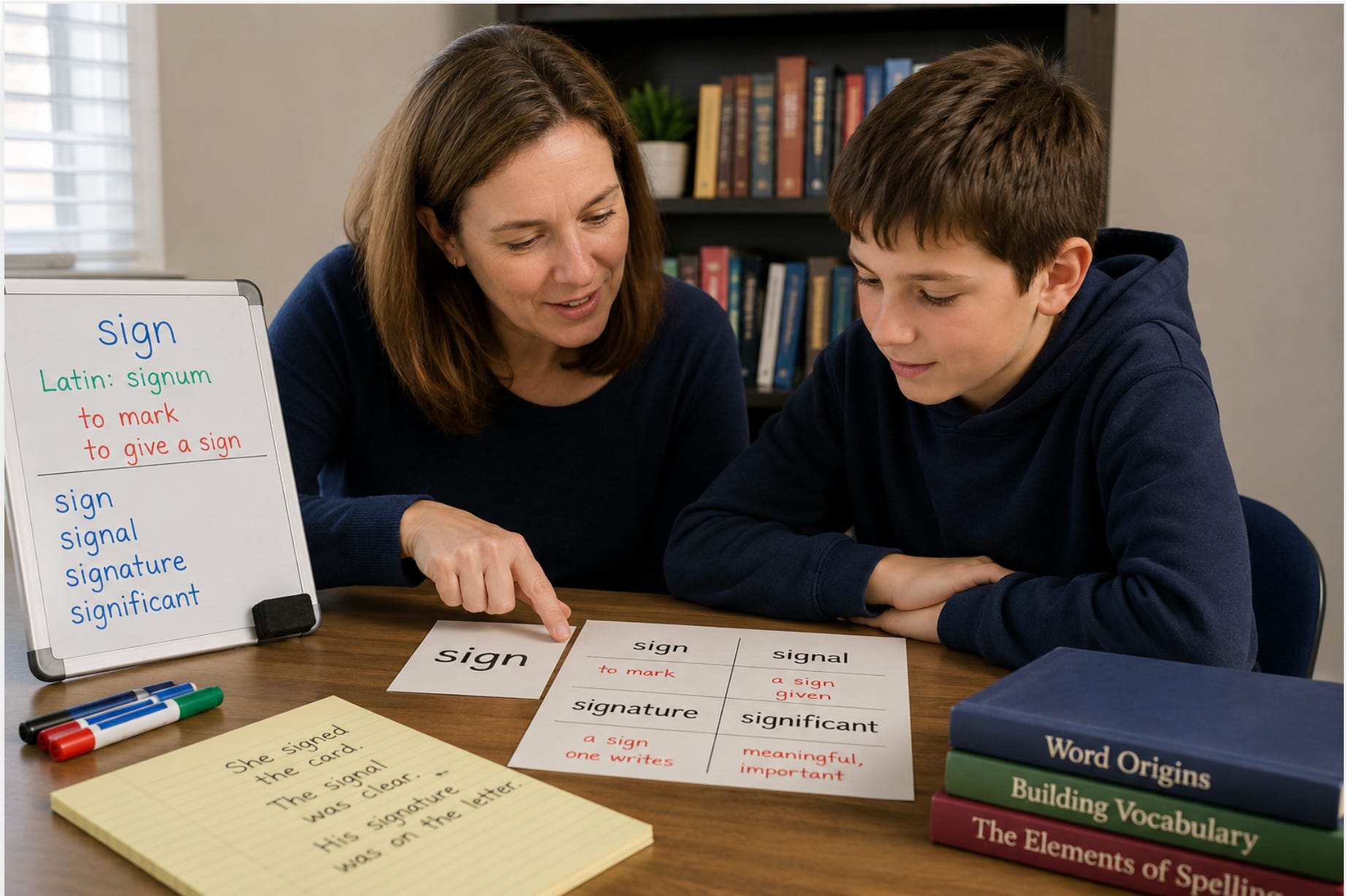
A child studying “sign,” “signal,” and “signature” is not just practicing a spelling pattern. The child is learning that spelling can preserve meaning across changes in pronunciation. A child studying “act,” “action,” “active,” and “actor” is not memorizing a list. The child is learning how a base can build a family and how suffixes affect meaning and grammar. A child studying word sums and matrices is not completing a worksheet task. The child is learning to analyze and synthesize the written structure of words.
That is very different from asking a child to memorize rules, exceptions, syllable types, key words, and sound-spelling patterns with the hope that enough repetition will finally make the system stable.
Some children can survive that kind of instruction. Some even do well with it. But the children who end up in private intervention are often not those children.
Many of them have already had explicit phonics instruction. They have already practiced the sound drills. They have already marked syllables. They have already read decodable texts. They have already learned strategies for “irregular” words. They have already been told to try again, practice more, read faster, sound it out, break it apart, and remember the rule.
If that worked, they would not be sitting in front of another private interventionist years later.
Parents need to ask better questions before choosing private help. Asking “Is this evidence-based?” is not enough because almost everyone will say yes. Asking “Is this structured literacy?” is not enough because that label has become so broad that it may tell you very little about what will actually happen in the session.
A better question is, “What is organizing the instruction?”
Parents should ask whether the provider starts with isolated sounds and spelling patterns, or whether words are studied through meaning, morphology, etymology, and phonology together. They should ask whether the child will study words in actual families, not rhyming lists or words grouped only because they share a sound. They should ask whether morphology is central from the beginning or added after a phonics sequence. They should ask how the provider explains words that are usually called irregular. If the answer is mostly “that word is an exception,” “that is a sight word,” or “you just have to remember it,” that is a warning sign.
Struggling learners have usually had plenty of practice being told to remember things. The problem is not that no one has repeated the information enough. The problem is often that the explanation has not been strong enough to hold.
Parents should also ask how spelling, reading, vocabulary, and writing will be connected. A strong intervention should not isolate spelling from language. Children need to use the words they study in sentences. They need to understand how suffixes change the grammar of words. They need to see how word study supports comprehension, oral language, written expression, and academic vocabulary.
If a provider cannot explain how the intervention supports writing, something is missing.
Parents should also ask how progress will be measured. Progress should not be reduced to speed. A child who has spent years guessing, rushing, or performing reading behaviors without understanding the structure underneath may slow down at first when they begin thinking carefully. That is not automatically a problem. Sometimes slowing down is part of learning to attend to the word instead of racing past it.
Progress should include the child’s ability to analyze words, synthesize words, explain spelling choices, recognize related words, use new vocabulary, read connected text with better understanding, and write with more control. Timed reading scores and weekly spelling tests may give some information, but they do not tell the whole story.
A parent should also ask, “What will you do if my child is not making durable progress?”
This may be the most revealing question. Too many struggling learners are kept in the same kind of intervention for years because the adult assumes the child needs more practice. Sometimes the child does not need more practice with the same model. The child needs a different way into the writing system.
Private intervention should be responsive. It should not require the child to fit the program.
It should not keep blaming the child’s memory, attention, effort, or severity when the instructional framework is not giving the child enough structure to think with. A good interventionist should be able to explain what the child is studying, why it was chosen, what the child is beginning to understand, and what needs to happen next.
And that is what private intervention should be able to offer: not just the implementation of a program, not just a person following a script, checking boxes, and moving through a sequence, but skilled teaching from someone who actually understands how the writing system works and can respond to the child in front of them.
A program cannot do that by itself. A skilled interventionist can notice when a child is relying on guessing, when a spelling explanation is not holding, when a word family needs to be expanded, when a suffix needs to be studied through grammar, when etymology will clarify the spelling, and when phonology belongs in the discussion. That is the work families are paying for. Not a prettier version of the same phonics-first routine. Not a binder. Not a brand. Actual intervention.
Parents should not expect magic. Structured Word Inquiry is not a trick. It is not a quick worksheet packet. It is not morphemes sprinkled on top of phonics. It requires knowledge, care, and skilled teaching.
But for many struggling learners, especially children who have already had years of phonics-first intervention, SWI gives them something they have not been given before. It gives them access to the logic of English spelling.
Schools may have constraints. Private practitioners have more freedom. If we are working outside the school system with children who have already been failed by sound-first instruction, then we should use that freedom well. We should not keep selling families another version of the same model and calling it progress because the packaging has changed.
The question is not whether instruction is structured. The question is whether the structure matches the system the child is trying to learn.